Meetings Archive

Distinguished Lecture Series: Lauren Williams

11 – 13 April 2022 University of Bristol

We are very pleased to announce the 2022 Heilbronn Distinguished Lecture Series will be given by Lauren K Williams, Harvard University.

The talks will be held over three days in hybrid form at the School of Mathematics in the Fry Building:

Monday 11th April 2022 16.00, colloquium followed by a wine reception from 17.00

Tuesday 12th April 2022 16.00

Wednesday 13th April 2022 16.00

Please visit the event website to register

We are pleased to announce that we are able to consider applications for funding to support care costs*

This event is organised in collaboration with the University of Bristol

*Applies to expenses incurred exceptionally as a result of attending the lecture series. Please contact heilbronn-coordinator@bristol.ac.uk for further information.

Join the Heilbronn Event mailing list to keep up to date with our upcoming events.

Continue Reading

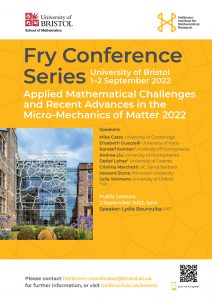
Fry Conference Series: Applied Mathematical Challenges and Recent Advances in the Micro-Mechanics of Matter 2022

Understanding the mechanical behaviour of solids, liquids and soft and biological materials requires insight into phenomena at different length scales (from bacterial films to volcanic flows). They are both a scientific challenge and an important technological problem. An overarching framework is provided by the name “micro-mechanics”. Combining techniques from continuum mechanics, dynamical systems and statistical mechanics, micro-mechanics uses knowledge of their microscopic structure to make predictive models of the mechanical properties of liquids, solids and soft matter.

Taking place over two days, this international conference features a distinguished line up of speakers, covering a broad range of topics in the micro-mechanics of fluids and materials.

This is event is part of the Fry Conference Series, being held to celebrate the move of the School of Mathematics at the University of Bristol to the recently refurbished Grade II listed Fry Building at the heart of the university campus.

Visit the event website for more information.

Speakers to include:

Lydia Bourouiba, MIT [Public Lecture]

Mike Cates, University of Cambridge

Elisabeth Guazzelli, University of Paris

Randall Kamien, University of Pennsylvania

Andrea Liu, University of Pennsylvania

Detlef Lohse*, University of Twente

Cristina Marchetti, UC Santa Barbara

Howard Stone, Princeton University

Julia Yeomans, University of Oxford

*Virtual talk


Register here.

Registration closes on 24th August 2022 at 23:59 BST. For more information please contact heilbronn-coordinator@bristol.ac.uk.

Join the Heilbronn Event mailing list to keep up to date with our upcoming events.

Continue Reading

Quantum Computing Theory in Practice

The third Quantum Computing Theory in Practice (QCTIP) workshop will be held at the University of Bristol, UK. Continuing the previous series of Heilbronn quantum algorithms meetings (2010-2019) hosted in Bristol and Cambridge, QCTIP fosters discussion between theorists and practitioners of quantum computing.

The workshop includes keynote speakers, invited and contributed talks from academia and industry, a poster session and a panel discussion.

Contact information

Visit the event website for further information.

Continue Reading

15th Algorithmic Number Theory Symposium

The ANTS meetings, held biannually since 1994, are the premier international forum for the presentation of new research in computational number theory and its applications. They are devoted to algorithmic aspects of number theory, including elementary number theory, algebraic number theory, analytic number theory, geometry of numbers, algebraic geometry, finite fields, and cryptography.

The 15th edition of ANTS will be held at the University of Bristol, from 8 to 12 August, 2022.

For further information and to book your place, please visit the event website here.

Continue Reading

The charm of integrability – Honoring the scientific contributions of Alexander Its on the occasion of his 70th birthday

The goal of this conference is to bring together experts and young researchers, mathematicians and physicists, scientists with different backgrounds and different takes on integrable systems theory, to discuss the latest achievements in this dynamic field and to point at future research directions within the discipline. At the same time the meeting will serve to honour Alexander Its, a world renowned expert in the field, for his many ground-breaking contributions to the theory of integrable systems over the past 40 years, on the occasion of his 70th birthday.

The full list of invited speakers can be found below.

View the programme here.

The conference will be zoom live streamed. Please contact maths-conference-administrator@bristol.ac.uk for access details.


Registration 

Registration has now closed.


Funding 

Limited funds are available for financial support, covering accommodation, and priority will be given to early career researchers, especially to those that will present a poster at the poster session. To be considered for financial support, participants are asked to complete the financial support form after completing their registration. Funding will be allocated on a first-come-first-serve basis. The last date to be considered for funding is August 26th.


Venue and accommodation 

The event will take place at the School of Mathematics, Fry Building, Woodland Road, Bristol. BS8 1UG.

Information on accommodation options can be found by visiting the Visit Bristol website. 


Invited speakers: 

Jinho Baik (University of Michigan)

Title: Multi-point distribution of (periodic) KPZ fixed points and differential equations

Abstract: The KPZ fixed point and its periodic version are two-dimensional random fields that are expected to be the universal limit of many random growth models and interacting particle systems. Their multi-point distributions were evaluated recently. We show that the involved Fredholm determinants can be expressed in terms of Its-Izergin-Korepin-Slavnov integrable operators. We then discuss the matrix integrable differential equations that these operators satisfy. These equations include matrix NLS with complex time, matrix mKdV, matrix KP, and multi-component KP hierarchy.

Estelle Basor (American Institute of Mathematics)

Title: Asymptotics of determinants of block Toeplitz matrices with symbols having jump discontinuities

Abstract: Well known classical theorems describe the asymptotics of finite Toeplitz matrices with scalar symbols of Fisher-Hartwig type. This talk will extend the classical results to the block case for symbols with jump discontinuities using an operator theory approach. 

Marco Bertola (Concordia University)

Title: Dim retrograde solitons and degenerate Riemann surfaces.

I will report on recent work with Alexander Tovbis and Bob Jenkins on how to compute effective formulas for the partial degeneration of Theta functions on nodal surfaces. As an application we provide the study of solitons on stationary  cnoidal background of the KdV equation. Some interesting physical phenomena include the fact that the “solitons” are now more like wave-packets with distinct group and phase velocities. The group velocity may be positive  (as usual) or negative (retrograde solitons). Moreover the explicit formula allows for the study of the soliton-on-soliton scattering matrix. 

Pavel Bleher (IUPUI School of Science)

Title: Ensembles of Random Matrices with Complex Potentials:Phase Diagrams and Topological Expansion

Abstract: We will discuss recent rigorous results on ensembles of random matrices withcomplex potentials, including topological expansion and phase diagrams in these ensembles inthe complex phase space of parameters. This is an ongoing project with Ahmad Barhoumi,Marco Bertola, Alfredo Dea ̃no, Roozbeh Gharakhloo, Ken McLaughlin, Alex Tovbis, andMaxim Yattselev.

Alexander Bobenko (Technische Universität Berlin)

Title: Integrability for geometry: Is a surface characterized by its metric and curvatures?

Abstract: We consider a classical problem in differential geometry, known as the Bonnet problem, whether a surface in three space is characterized by its metric and mean curvature function. Generically, the answer is yes. Special cases when it is not the case are classified. In the first part we consider Bonnet surfaces, which are surfaces (with non-constant mean curvature) possessing continuous families of isometries preserving mean curvature. Their global classification is given using the theory of Painleve equations. In the second part, which is a recent joint work with Tim Hoffmann and Andrew Sageman-Furnas, we explicitly construct a pair of immersed tori that are related by a mean curvature preserving isometry. Integrable systems play a crucial role in this construction. This resolves a longstanding open problem on whether the metric and mean curvature function determine a unique compact surface.

Mattia Cafasso (Université Angers)

Title:The finite temperature discrete Bessel kernel and integrable equations

Abstract: Using the theory of discrete integrable operators and discrete Riemann-Hilbert problems, I will show that the largest particle distribution of the point process associated to the finite-temperature discrete Bessel kernel satisfies some interesting integrable equations such as, for example, the cylindrical Toda equation. This is a joint work with Giulio Ruzza.

Tom Claeys (UCLouvain)

Title:Weak and strong confinement in the Freud random matrix ensemble

Abstract: Eigenvalues of unitary invariant random matrices confined by a Freud weight $|x|^\beta$ exhibit a transition between classical random matrix statistics and Poisson statistics as $\beta$ decreases. We describe the gap probabilities in this ensemble as a function of $\beta$. The talk will be based on joint work with I. Krasovsky and A. Minakov.

Peter Clarkson (University of Kent)

Title: Orthogonal Polynomials and Symmetric Sextic Freud weights

Abstract: In this talk I will discuss orthogonal polynomials associated with symmetric sextic Freud weights. In particular I will describe properties of the recurrence coefficients in the three-term recurrence relation associated with these orthogonal polynomials. These recurrence coefficients satisfy a fourth-order discrete equation which is the second member of the first discrete Painleve hierarchy, also known as the string equation, and also satisfies a coupled system of second-order, nonlinear differential equations. The weight arises in the context of Hermitian matrix models and random matrices.This is joint work with Kerstin Jordaan (University of South Africa) and Ana Loureiro (University of Kent).

Tamara Grava (University of Bristol)

Title: Gibbs ensemble for Integrable Systems and random matrices

We consider discrete integrable systems with random initial data and connect them with the theory of random matrices. We will consider the Toda lattice whose Gibbs ensemble has been connected by H. Spohn to the Gaussian beta-ensemble at high temperature. We then consider the defocusing nonlinear Schrodinger equation in its integrable version, that is called Ablowitz Ladik lattice. In the random initial data setting the Lax matrix of the Ablowitz Ladik lattice turns into a random matrix that is related to the circular beta-ensemble at high temperature. We obtain the density of states of the random Lax matrix, when the size of the matrix goes to infinity, by establishing a mapping to the one-dimensional log-gas. The density of states is obtained via a particular solution of the double-confluent Heun equation.

Jon Keating (University of Oxford)

Title: Multifractal eigenfunctions in intermediate systems

Abstract: I will discuss two systems that are intermediate between integrability and chaos, and for which the quantum eigenfunctions exhibit multifractal scaling. This is joint work with Henrik Ueberschär.

Vladimir Korepin (Stony Brook University)

Title: Lattice Nonlinear Schrodinger Equation

Abstract: History, applications and open problems will be considered.  We shall mainly pay attention to the quantum case.

Igor Krasovsky (Imperial College London)

Title: Asymptotics of the sine- and Airy-kernel determinants on two large intervals

Abstract: We consider the probability of 2 large gaps without eigenvalues in the local scaling limits in the bulk and at the edge of the spectrum of the Gaussian Unitary Ensemble of random matrices. We determine the multiplicative constants in the relevant asymptotics. In the bulk, the asymptotics without determination of the constant were found in 1997 by Deift, Its, and Zhou (in the general case of n gaps).

To obtain our results, we used a differential identity with respect to the gap edges and the observation that when the gaps are far apart, they are asymptotically independent, and so we can make use of the known constant for the one-gap asymptotics. The integration of the differential identity was the most challenging task due to theta-functions involved in the formulae. This is a joint work with Benjamin Fahs (sine-kernel) and Theo-Harris Maroudas (Airy-kernel).

Arno Kuijlaars (KU Leuven)

Title: Critical measures on higher genus Riemann surface

Abstract:I will report on recent work with Marco Bertola and Alan Groot on the definition and properties of critical measures on compact Riemann surfaces.

Our work is inspired by random tilings with periodic weights  that can be analyzed via matrix valued orthogonal polynomials. The matrix valued orthogonality can be viewed as scalar orthogonality on a Riemann surface, and the critical measures provide a step towards an understanding of their asymptotic behavior.

Oleg Lisovyy (Université de Tours)

Title: Perturbative connection formulas for Heun equations

Abstract: Connection formulas relating Frobenius solutions of linear ODEs at different Fuchsian singular points can be expressed in terms of the large order asymptotics of the corresponding power series. We demonstrate that for the usual, confluent and reduced confluent Heun equation, the series expansion of the relevant asymptotic amplitude in a suitable parameter can be systematically computed to arbitrary order. This allows to check a recent conjecture of Bonelli-Iossa-Panea Lichtig-Tanzini expressing the Heun connection matrix in terms of quasiclassical Virasoro conformal blocks.

Peter Miller (University of Michigan)

Title: On the algebraic solutions of the Painlev\’e-III (D$_7$) equation

Abstract: The D$_7$ degeneration of the Painlev\’e-III equation has solutions that are rational functions of $x^{1/3}$ for certain parameter values. We apply the isomonodromy method to obtain a Riemann-Hilbert representation of these solutions. We demonstrate the utility of this representation by analyzing rigorously the behavior of the solutions in the large parameter limit.  This is joint work with Robert Buckingham (Cincinnati).  If time permits, we will describe an interesting related calculation that we learned about 10 years ago from Alexander Its.

Beatrice Pelloni (Heriot Watt University)

Title: Novelty and surprises in the theory of third-order boundary value problems.

Abstract: I will review the results for differential operators an integrable PDEs of odd-order, when posed on bounded domains. The original  motivation for this work was the desire to understand the solution of a famous integrable PDE, the Kortweg-deVries equation.  The doors to these results  have been unlocked by the  understanding of the behaviour of linear third-order boundary values problems, that have been studied over the last 20 years by means of the Unified Transform. In some non-self-adjoint cases, this approach yields a spectral diagonalisation of the operator. More generally, I will highlight the  dependence of these problems on the specific boundary conditions and how this differs fundamentally from the even-order case. Novel and surprising examples arise for “Dirichlet-type” boundary conditions, as well as for quasi-periodic and time-periodic ones. I will also comment on some results for the nonlinear KdV case.

Nicolai Reshetikhin (University of California, Berkeley)

Title: Superintegrable systems on moduli spaces of flat connections.

Abstract: After a short review of superintegrability I will focus on superintegrable systems on moduli spaces of flat connections and on quantization of  these systems. Quantum Hamiltonians of such systems have simple meaning in terms of corresponding topological quantum field theory.

Nina Snaith (University of Bristol)

Title: A stochastic model for the spacing of replication origins on chromosomes

Abstract: In joint work with Huw Day we probe the statistical distribution of origins of DNA replication on eukaryotic chromosomes and develop a stochastic model for the replication process.

Leon Takhtajan (Stony Brook University)

Title: New supersymmetric localization principle

Abstract: I will present a new supersymmetric localization principle, with application to trace formulas for a full partition function. Unlike the standard localization principle, this new principle allowsto compute the supertrace of non-supersymmetric observables, and is based on the existence of fermionic zero modes. This is a joint work with Changha Choi, arXiv:2112.07942.

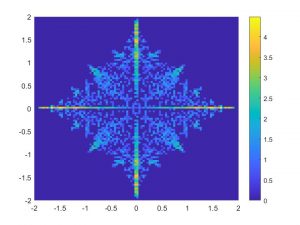
Self-similar fractal structures in tri-diagonal random matrices.

Self-similar fractal structure                                                                                                

Self-similar fractal structures in tri-diagonal random matrices.

Images of fractal structures courtesy of  Henry Taylor

Contacts 

Please contact Louisa Bartoszewicz regarding any administrative aspects of the conference. 


Organising committee:  

Thomas Bothner (University of Bristol) 

Tamara Grava (University of Bristol; International School for Advanced Studies (SISSA/IAS) 

Ken McLaughlin (Colorado State University) 

Andrei Prokhorov (University of Michigan) 

Continue Reading

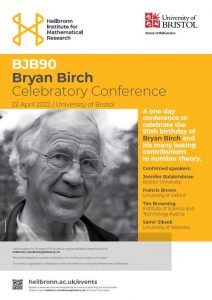
BJB90 – Bryan Birch Celebratory Conference

UPDATE: BJB90 has been rescheduled to 22nd April 2022. All original registrants will be transferred to the new date.  

A one day conference to celebrate the 90th birthday of Bryan Birch and his many lasting contributions to number theory.

Visit the event website for further information.

Biography

Bryan Birch was educated at Trinity College, Cambridge where as a doctoral student he proved Birch’s theorem, one of the results to come out of the Hardy–Littlewood circle method; it shows that odd-degree rational forms in a large enough set of variables must have zeroes.

He then worked with Peter Swinnerton-Dyer on computations relating to the Hasse–Weil L-functions of elliptic curves. They formulated their conjecture relating the rank of an elliptic curve to the order of a certain zero of an L-function; it has been an influence on the development of number theory since the mid 1960s. They later introduced modular symbols.

In later work he contributed to algebraic K-theory (Birch–Tate conjecture). He then formulated ideas on the role of Heegner points (he had been one of those reconsidering Kurt Heegner’s original work, on the class number one problem, which had not initially gained acceptance). Birch put together the context in which the Gross–Zagier theorem was proved. He was elected a Fellow of the Royal Society in 1972; was awarded the Senior Whitehead Prize in 1993 and the De Morgan Medal in 2007. In 2012 he became a fellow of the American Mathematical Society. In 2020 he was awarded the Royal Society’s Sylvester Medal for his work in driving the theory of elliptic curves through the Birch–Swinnerton-Dyer conjecture and the theory of Heegner points. The Birch–Swinnerton-Dyer conjecture is one of the Clay Mathematics Institute Millennium Problems.

Registration is now open.


If you have any questions, please contact heilbronn-coordinator@bristol.ac.uk.

Join the Heilbronn Event mailing list to keep up to date with our upcoming events.

Continue Reading

PhD opportunities in mathematics

Join us for our annual PhD opportunities in mathematics event. This event is open to all undergraduate and masters students who are considering applying for a PhD in mathematics.

This event will be held in G.10, Fry Building.

Programme 

13:00 – 14:00 Graduate student panel

14:00 – 14:30 Industry speaker – Kathryn Leeming, British Geological Survey

14:30 – 15:00 Industry speaker – Laura 

15:00 – 15:15 Break 

15:15 – 15:45 Academic speaker – Asma Hassanezhad, University if Bristol

15:45 – 16:30 Information from the Post Grad team 

16:30 – 17:00 Informal discussions 

Register to attend

Please register for this event by completing the following form.

Contact information

For practical information please email maths-conference-administrator@bristol.ac.uk


Continue Reading

Colloquium – Emmanuel Breuillard

14:00 – 15:00pm

Online, Zoom Webinar

We’re very excited to welcome Emmanuel Breuillard (University of Cambridge), as a Heilbronn Virtual Visiting Professor.

Title: Approximate groups

Abstract: Symmetry is one of the most fundamental concepts of science and mathematics. Group theory is the field of mathematics devoted to its study. In this lecture we will discuss various situations where symmetry is present only partially and where a notion approximate symmetry arises naturally. In group theory this leads to the notion of approximate group, which has been much studied in the last twenty years in connection with various fields including additive combinatorics, harmonic and fractal analysis, asymptotic finite group theory, geometric group theory, ergodic theory and even logic and model theory. The lecture will introduce this concept and present some recent developments.

For more information and to register please visit the event website.


For more information, please contact heilbronn-coordinator@bristol.ac.uk.

Join the Heilbronn Event mailing list to keep up to date with our upcoming events.
An additional talk will be given by Emmanuel Breuillard as part of the Ergodic Theory and Dynamical Systems Seminars. For further information please the event website.

Continue Reading

Distinguished Lecture Series: Amie Wilkinson

Online, Zoom Webinars

We’re pleased to announce that Amie Wilkinson’s (University of Chicago) postponed Distinguished Lecture series from May 2020 has now been rescheduled to May 2021. The colloquia details will be confirmed shortly. Visit the event website for further information.

The talks will be over three days:

10 May 2021, 16:00 – 17:00

12 May 2021, 16:00 – 17:00

14 May 2021, 16:00 – 17:00

Registration is now open.


If you have any questions, please contact heilbronn-coordinator@bristol.ac.uk.

Join the Heilbronn Event mailing list to keep up to date with our upcoming events.

Continue Reading
css.php