Meetings Archive

Colloquium – Sir Bernard Silverman, FRS, University of Oxford

Title: Science and Mathematics in Government: DNA Profiles, Border Security and Modern Slavery

Science and mathematics are relevant to a very wide range of Government policies and operations. For example, if someone is arrested but not charged, for how long should their DNA profile be retained? How should resources be allocated to queues at the border? How many victims of modern slavery and human trafficking are there in the UK today? Professor Silverman will discuss these and other aspects of his work as Chief Scientific Adviser to the Home Office, and will reflect more broadly on issues around the contribution of science to public policy.

The talk will be held from 4.30pm in Frank Lecture Theatre (G44), Physics, and will be followed by a drinks reception in the Maths common room.
Continue Reading

Advanced School in Liquids and Complex Fluids: ‘Solutions in Spring’

Event Information 

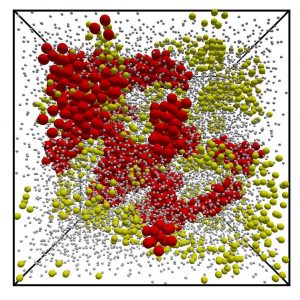
The aim of this yearly school is to provide a comprehensive foundation for researchers and PhD students in the field of liquids and complex fluids.

Please note that registration has now closed


Programme

Wednesday 6th June

10:30 – Arrival and Welcome
11:15 – Lecture — Laurence Wilson (Experimental studies of life at low Reynolds number – Experimental scattering methods applied to swimming microorganisms)
12:00 – Lunch
13:30 – Lecture — Karen Edler (Use of scattering methods for complex fluids 1)
14:15 – Lecture – Laurence Wilson (Experimental studies of life at low Reynolds number – Chemotaxis and microorganism navigation)
15:00 – Refreshments
15:30 – Poster session
19:00 – Dinner

Thursday 7th June

09:15 – Lecture – Wuge Briscoe (Intermolecular and surface forces in soft matter 1)
10:00 – Lecture – Thomas Speck (Dynamical arrest – Introduction/Theories of the supercooled state)
10:45 – Refreshments
11:15 – Lecture – Wuge Briscoe (Intermolecular and surface forces in soft matter 2)
12:00 – Lunch
13:30 – Lecture – Karen Edler (Use of scattering methods for complex fluids 2)
14:15 – Lecture — Wuge Briscoe (Intermolecular and surface forces in soft matter 3)
15:30 – Refreshments
16:00 – Lecture — Laurence Wilson (Experimental studies of life at low Reynolds number – Imaging and analysis of life at low Reynolds number
16:45 – Workshop — Laurence Wilson (Experimental studies of life at low Reynolds number)
17:30 – Networking session
19:00 – Dinner

Friday 8th June

09:15 – Lecture – Robert Jack (Non-equilibrium dynamics in complex fluids 1)
10:00 – Workshop – Wuge Briscoe (Intermolecular and surface forces in soft matter)
10:45 – Refreshments
11:15 – Lecture – Robert Jack (Non-equilibrium dynamics in complex fluids 2)
12:00 – Lunch
13:30 – Workshop – Robert Jack (Non-equilibrium dynamics in complex fluids)
14:45 – Excursion / dinner

Saturday 9th June
09:15 – Lecture – Thomas Speck (Dynamical arrest – Role of structure)
10:00 – Workshop – Karen Edler (Use of scattering methods for complex fluids)
10:45 – Refreshments
11:15 – Lecture – Thomas Speck (Dynamical arrest – Deep in the glass)
12:00 – Prize Award Session
12:15 – Lunch and departure


Invited speakers 

Wuge Briscoe (University of Bristol) – Title: Intermolecular and surface forces in soft matter

Karen Edler (University of Bath) – Title: Use of scattering methods for complex fluids

Robert Jack (University of Cambridge) – Title: Non-equilibrium dynamics in soft matter

Thomas Speck (Mainz University) – Title: Dynamical arrest in supercooled liquids and glasses

Laurence Wilson (University of York) – Title: Soft matter in biological physics

Jorge Kurchan (ESPCI Paris) – Title: TBA


Cost

IOP Member: £40.00

IOP Non -Member: £52.00


Time

9:15am- 6:00pm


Venue

School of Mathematics, University of Bristol, University Walk, Clifton, Bristol, BS8 1TW


Accommodation 

Attendees will need to make their own accommodation arrangements.

For planning purposes the venue is located within the main University precinct, postcode BS8 1TW. Information on local hotels and average prices can be found here. Alternatively you can find further information on other accommodation options by visiting the Visit Bristol website.


Contacts

Professor Tanniemola B Liverpool, University of Bristol

Dr Anita Zeidler, University of Bath

Dr Valeria Garbin, Imperial College London


Continue Reading

One two many: why is 3 so much bigger than 2?

All over mathematics there are examples where changing a 2 to a 3 turns a doable problem into a completely unmanageable one.  What on earth is going on?

This talk forms part of the Matrix series of evening talks, designed to show off bits of maths that you won’t see in lectures – no special knowledge required!


The talk will be held in Mott Lecture Theatre, Physics, from 6pm – 7pm.
Continue Reading

Colloquium – Prof. Jim Davis, University of Richmond

Due to today’s weather conditions this talk has been cancelled. Apologies for any inconvenience caused.

Title: Apple vs. Samsung. A mathematical battle

Apple and Samsung have been fighting patent battles around the world. Come learn about the mathematics at the heart of one of these battles, the error correcting codes used in 3G communication. We will give a gentle introduction to coding theory, explain why this caused a legal battle, and we will conclude by describing why President Obama ultimately vetoed the ruling by the court (the first time a president had used that veto power in nearly 30 years!). Also, come to find out how Bristol played a crucial role in this story.


The talk will be held from 4.30pm in Powell Lecture Theatre, Physics, and will be followed by a drinks reception in the Maths common room.
Continue Reading

BOWL

This is the seventh 1-day meeting in additive combinatorics and analytic number theory and will take place at the University of Bristol. The event is funded by an LMS Scheme 3 Grant (31623) and the School of Mathematics at the University of Bristol.

Programme

13:00-13:15: registration

13:15-13:55: Stephen Lester (QMUL)
Mass equidistribution for half-integral weight modular forms

14:00-14:40: Brendan Murphy (Bristol)
TBC

14:45-15:25: James Aaronson (Oxford)
Sets of Integers with many Solutions to a Linear Equation

15:30-16:00 coffee break

16:00-16:40: Adelina Manzateanu (Bristol)
Rational curves on cubic hypersurfaces over Fq

16:45-17:25: Mohammad Bardestani (Cambridge)
Polynomial configurations in sets of positive upper density over local fields


Continue Reading

Heilbronn Colloquium

Henry Cohn, Microsoft

The sphere packing problem in dimensions 8 and 24

What is the densest packing of congruent spheres in Euclidean space? This problem arises naturally in geometry, number theory, and information theory, but it is notoriously difficult to solve, and until recently no sharp bounds were known above three dimensions. In 2016 Maryna Viazovska found a remarkable solution of the sphere packing problem in eight dimensions. In this talk I’ll describe how her breakthrough works and where it comes from, as well as follow-up work extending it to twenty-four dimensions (joint work with Kumar, Miller, Radchenko, and Viazovska).

16.00 20th February 2018

SM1, Main Building, University of Bristol

Title to be announced. The colloquium will be followed by a wine reception in the Common Room at the Main Maths Building.

To help us arrange catering and space, please complete the short registration form if you are planning on attending.

Continue Reading

How to Win a Million Dollars – Sophie Stevens

Some problems are easy. Some problems are hard. Some problems seem so hard that they’ve got a bounty to their name. One such problem is a meta-problem: a problem about problems. Or, to give it a name, P vs NP: are problems really as hard as we think they are? If so, what does this mean for maths, computing and even humanity itself? This talk will introduce and explain the problem, hardness and complexity theory. And who knows, maybe you’ll even win a million dollars…

This talk forms part of the Matrix series of evening talks, designed to show off bits of maths that you won’t see in lectures – no special knowledge required!

The talk will be held in Mott Lecture Theatre, Physics, from 6pm – 7pm.


Continue Reading

Distinguished Lecture Series 2018

University of Bristol

The 2018 Distinguished Lecture Series will be given by Ingrid Daubechies, Duke.

The talks will be held over three days:

Wednesday 11th April 16.00 (Colloquium) 1.15 Queens Building

Thursday 12th April 16.00 SM1 Main Maths Building

Friday 13th April 14.00 4th Floor Seminar Room, Howard House **CHANGE OF TIME

Please register for the Colloquium here. Registration not required for the remaining more specialised talks.

Title and abstract for Colloquium:

Wavelets, with Image processing applications for Art History

Wavelets are the building blocks for mathematical tool that emerged in
the 1980s as an interesting way to decompose, understand and compute
with signals, data and operators. The talk will review the basics of
wavelets and their mathematical properties; in a second part, we will
visit some recent applications of wavelets and image processing to
help understand art works, their manufacture process and  their state of
conservation.

Talk 2

Thursday 12th April: Adaptive time-frequency localisation. 16.00, SM1 Main Building Maths

Talk 3

Friday 13th April: Biologically relevant distances between surfaces. 14.00, 4th Floor Seminar Room, Howard House 

Support for travel for UK based PhD students may be available, please contact heilbronn-coordinator@bristol.ac.uk with any requests by Monday 12th March 2018.

We are pleased to announce that we are able to consider applications for funding to support care costs*

This event is organised in collaboration with the Heilbronn Institute of Mathematical Research.
*Applies to expenses incurred exceptionally as a result of attending the lecture series. Please contact heilbronn-coordinator@bristol.ac.uk for further information.
** CHANGE OF TIME AND LOCATION – The Friday 13th talk has been changed to 14.00 and will take place in the 4th Floor seminar room at Howard House, Queen’s Road.
Continue Reading
css.php