
Benjamin Meaker visiting Professor: Peter Smith Date: 18 July 2018 Time: 2pm Location: Howard House, Level 4 Seminar Room Although we take them for granted, mobile devices such as smart phones are small miracles of engineering and electronics. These devices are constantly evolving and fundamental research and long term planning is always running in parallel […]
Archive | Events
Graduate student lecture: Random matrices in wireless communication systems
Benjamin Meaker visiting Professor: Peter Smith Date: 23 July 2018 Time: 2pm Location: Howard House, Level 4 Seminar Room This talk will outline the many applications of random matrices in communications. In particular, modern cellular systems where base stations communicate with many mobile users with smart phones are discussed. The modelling, design and analysis of […]
Departmental lecture: Asymptotics of large communication systems
Benjamin Meaker visiting Professor: Peter Smith Date: 26 July 2018 Time: 2pm Location: Howard House, Level 4 Seminar Room Large wireless communication networks are widely believed to offer “free” interference reduction. This has led to a huge growth of research in performance analysis of large systems, where many users communicate with 100s of antennas located […]
Open lecture: Smart phones and statistics – where is the connection?
Benjamin Meaker visiting Professor: Peter Smith Date: 18 July 2018 Time: 2pm Location: Howard House, Level 4 Seminar Room Although we take them for granted, mobile devices such as smart phones are small miracles of engineering and electronics. These devices are constantly evolving and fundamental research and long term planning is always running in parallel […]
UoB BMVP Eugene Bogomolny Public Lecture
 Title: Quantum chaos, ideas and methods
Professor Eugene Bogomolny, of CNRS, Paris-Sud offers a mini-review of ideas and methods of quantum chaos and their applications for different models ranging from nuclear physics to number theory.
The talk will be held from 5pm in SM1, School of Mathematics, and will be followed by a drinks reception in the Maths common room.
Colloquium – Professor Herbert Huppert, FRS, From Cambridge
 Title: How to frack into and out of trouble
After a short introduction to the mechanism and politics of fracking, the talk will concentrate on the fluid mechanics and elastodynamics of driving fluid into cracks in rocks. We will present the equations governing this response and also that when the pressure is released, and the system relaxes back partially towards equilibrium. The two main techniques for evaluating the consequences of the governing equations are numerical solutions and asymptotic analysis in certain useful limits, both of which we will describe. Videos of laboratory experiments will also be shown and the results compared with the theoretical predictions. While fracking is one motivating example of our analysis, the mathematics and physical responses described undoubtedly has applications to other areas of geophysics.
The talk will be held from 4.30pm in Mott Lecture Theatre (G12), Physics, and will be followed by a drinks reception in the Maths common room.
Heilbronn Colloquium Van Der Schaar
15 May 2018
16.00, SM1 Main Maths Building, University of Bristol
We are delighted to welcome Michaela van der Schaar, Oxford, to the University of Bristol for a Heilbronn Colloquium, followed by a wine reception in the common room/veranda.
Causal Inference for Treatment Effects: A Theory and Associated Learning Algorithms
Abstract: We investigate the problem of estimating the causal effect of a treatment on individual subjects from observational data; this is a central problem in various application domains, including healthcare, social sciences, and online advertising. We first develop a theoretical foundation of causal inference for individualized treatment effects based on information theory. Next, we use this theory, to construct an information-optimal Bayesian causal inference algorithm. This algorithm embeds the potential outcomes in a vector-valued reproducing kernel Hilbert space and uses a multi-task Gaussian process prior over that space to infer the individualized causal effects. We show that our algorithm significantly outperforms the state-of-the-art causal inference algorithms. The talk will conclude with a discussion of the impact of this work on precision medicine and clinical trials.
If you haven’t already registered and are intending to come, please use the short registration form to let us know of your attendence.
Colloquium – Sir Bernard Silverman, FRS, University of Oxford
 Title: Science and Mathematics in Government: DNA Profiles, Border Security and Modern Slavery
Science and mathematics are relevant to a very wide range of Government policies and operations. For example, if someone is arrested but not charged, for how long should their DNA profile be retained? How should resources be allocated to queues at the border? How many victims of modern slavery and human trafficking are there in the UK today? Professor Silverman will discuss these and other aspects of his work as Chief Scientific Adviser to the Home Office, and will reflect more broadly on issues around the contribution of science to public policy.
The talk will be held from 4.30pm in Frank Lecture Theatre (G44), Physics, and will be followed by a drinks reception in the Maths common room.
Advanced School in Liquids and Complex Fluids: ‘Solutions in Spring’
 Event Information
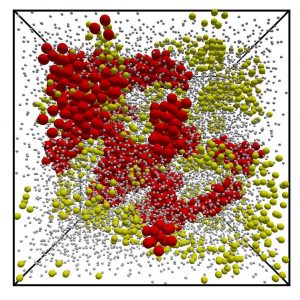
The aim of this yearly school is to provide a comprehensive foundation for researchers and PhD students in the field of liquids and complex fluids.
Please note that registration has now closed
Programme
Wednesday 6th June
10:30 – Arrival and Welcome
11:15 – Lecture — Laurence Wilson (Experimental studies of life at low Reynolds number – Experimental scattering methods applied to swimming microorganisms)
12:00 – Lunch
13:30 – Lecture — Karen Edler (Use of scattering methods for complex fluids 1)
14:15 – Lecture – Laurence Wilson (Experimental studies of life at low Reynolds number – Chemotaxis and microorganism navigation)
15:00 – Refreshments
15:30 – Poster session
19:00 – Dinner
Thursday 7th June
09:15 – Lecture – Wuge Briscoe (Intermolecular and surface forces in soft matter 1)
10:00 – Lecture – Thomas Speck (Dynamical arrest – Introduction/Theories of the supercooled state)
10:45 – Refreshments
11:15 – Lecture – Wuge Briscoe (Intermolecular and surface forces in soft matter 2)
12:00 – Lunch
13:30 – Lecture – Karen Edler (Use of scattering methods for complex fluids 2)
14:15 – Lecture — Wuge Briscoe (Intermolecular and surface forces in soft matter 3)
15:30 – Refreshments
16:00 – Lecture — Laurence Wilson (Experimental studies of life at low Reynolds number – Imaging and analysis of life at low Reynolds number
16:45 – Workshop — Laurence Wilson (Experimental studies of life at low Reynolds number)
17:30 – Networking session
19:00 – Dinner
Friday 8th June
09:15 – Lecture – Robert Jack (Non-equilibrium dynamics in complex fluids 1)
10:00 – Workshop – Wuge Briscoe (Intermolecular and surface forces in soft matter)
10:45 – Refreshments
11:15 – Lecture – Robert Jack (Non-equilibrium dynamics in complex fluids 2)
12:00 – Lunch
13:30 – Workshop – Robert Jack (Non-equilibrium dynamics in complex fluids)
14:45 – Excursion / dinner
Saturday 9th June
09:15 – Lecture – Thomas Speck (Dynamical arrest – Role of structure)
10:00 – Workshop – Karen Edler (Use of scattering methods for complex fluids)
10:45 – Refreshments
11:15 – Lecture – Thomas Speck (Dynamical arrest – Deep in the glass)
12:00 – Prize Award Session
12:15 – Lunch and departure
Invited speakers
Wuge Briscoe (University of Bristol) – Title: Intermolecular and surface forces in soft matter
Karen Edler (University of Bath) – Title: Use of scattering methods for complex fluids
Robert Jack (University of Cambridge) – Title: Non-equilibrium dynamics in soft matter
Thomas Speck (Mainz University) – Title: Dynamical arrest in supercooled liquids and glasses
Laurence Wilson (University of York) – Title: Soft matter in biological physics
Jorge Kurchan (ESPCI Paris) – Title: TBA
Cost
IOP Member: £40.00
IOP Non -Member: £52.00
Time
9:15am- 6:00pm
Venue
School of Mathematics, University of Bristol, University Walk, Clifton, Bristol, BS8 1TW
Accommodation
Attendees will need to make their own accommodation arrangements.
For planning purposes the venue is located within the main University precinct, postcode BS8 1TW. Information on local hotels and average prices can be found here. Alternatively you can find further information on other accommodation options by visiting the Visit Bristol website.
Contacts
Professor Tanniemola B Liverpool, University of Bristol
Dr Anita Zeidler, University of Bath
Dr Valeria Garbin, Imperial College London
One two many: why is 3 so much bigger than 2?
 All over mathematics there are examples where changing a 2 to a 3 turns a doable problem into a completely unmanageable one. What on earth is going on?
This talk forms part of the Matrix series of evening talks, designed to show off bits of maths that you won’t see in lectures – no special knowledge required!
The talk will be held in Mott Lecture Theatre, Physics, from 6pm – 7pm.
