
The goal of this conference is to bring together experts and young researchers, mathematicians and physicists, scientists with different backgrounds and different takes on integrable systems theory, to discuss the latest achievements in this dynamic field and to point at future research directions within the discipline. At the same time the meeting will serve to honour Alexander Its, a world renowned expert in the field, for his many ground-breaking contributions to the theory of integrable systems over the past 40 years, on the occasion of his 70th birthday.
The full list of invited speakers can be found below.
The conference will be zoom live streamed. Please contact maths-conference-administrator@bristol.ac.uk for access details.
 .
. 
Registration
Registration has now closed.
Funding
Limited funds are available for financial support, covering accommodation, and priority will be given to early career researchers, especially to those that will present a poster at the poster session. To be considered for financial support, participants are asked to complete the financial support form after completing their registration. Funding will be allocated on a first-come-first-serve basis. The last date to be considered for funding is August 26th.
Venue and accommodation
The event will take place at the School of Mathematics, Fry Building, Woodland Road, Bristol. BS8 1UG.
Information on accommodation options can be found by visiting the Visit Bristol website.
Invited speakers:
Jinho Baik (University of Michigan)
Abstract: The KPZ fixed point and its periodic version are two-dimensional random fields that are expected to be the universal limit of many random growth models and interacting particle systems. Their multi-point distributions were evaluated recently. We show that the involved Fredholm determinants can be expressed in terms of Its-Izergin-Korepin-Slavnov integrable operators. We then discuss the matrix integrable differential equations that these operators satisfy. These equations include matrix NLS with complex time, matrix mKdV, matrix KP, and multi-component KP hierarchy.
Estelle Basor (American Institute of Mathematics)
Abstract: Well known classical theorems describe the asymptotics of finite Toeplitz matrices with scalar symbols of Fisher-Hartwig type. This talk will extend the classical results to the block case for symbols with jump discontinuities using an operator theory approach.
Marco Bertola (Concordia University)
I will report on recent work with Alexander Tovbis and Bob Jenkins on how to compute effective formulas for the partial degeneration of Theta functions on nodal surfaces. As an application we provide the study of solitons on stationary cnoidal background of the KdV equation. Some interesting physical phenomena include the fact that the “solitons” are now more like wave-packets with distinct group and phase velocities. The group velocity may be positive (as usual) or negative (retrograde solitons). Moreover the explicit formula allows for the study of the soliton-on-soliton scattering matrix.
Pavel Bleher (IUPUI School of Science)
Abstract: We will discuss recent rigorous results on ensembles of random matrices withcomplex potentials, including topological expansion and phase diagrams in these ensembles inthe complex phase space of parameters. This is an ongoing project with Ahmad Barhoumi,Marco Bertola, Alfredo Dea ̃no, Roozbeh Gharakhloo, Ken McLaughlin, Alex Tovbis, andMaxim Yattselev.
Anne Boutet de Monvel (Université de Paris)
Alexander Bobenko (Technische Universität Berlin)
Abstract: We consider a classical problem in differential geometry, known as the Bonnet problem, whether a surface in three space is characterized by its metric and mean curvature function. Generically, the answer is yes. Special cases when it is not the case are classified. In the first part we consider Bonnet surfaces, which are surfaces (with non-constant mean curvature) possessing continuous families of isometries preserving mean curvature. Their global classification is given using the theory of Painleve equations. In the second part, which is a recent joint work with Tim Hoffmann and Andrew Sageman-Furnas, we explicitly construct a pair of immersed tori that are related by a mean curvature preserving isometry. Integrable systems play a crucial role in this construction. This resolves a longstanding open problem on whether the metric and mean curvature function determine a unique compact surface.
Mattia Cafasso (Université Angers)
Abstract: Using the theory of discrete integrable operators and discrete Riemann-Hilbert problems, I will show that the largest particle distribution of the point process associated to the finite-temperature discrete Bessel kernel satisfies some interesting integrable equations such as, for example, the cylindrical Toda equation. This is a joint work with Giulio Ruzza.
Tom Claeys (UCLouvain)
Abstract: Eigenvalues of unitary invariant random matrices confined by a Freud weight $|x|^\beta$ exhibit a transition between classical random matrix statistics and Poisson statistics as $\beta$ decreases. We describe the gap probabilities in this ensemble as a function of $\beta$. The talk will be based on joint work with I. Krasovsky and A. Minakov.
Peter Clarkson (University of Kent)
Abstract: In this talk I will discuss orthogonal polynomials associated with symmetric sextic Freud weights. In particular I will describe properties of the recurrence coefficients in the three-term recurrence relation associated with these orthogonal polynomials. These recurrence coefficients satisfy a fourth-order discrete equation which is the second member of the first discrete Painleve hierarchy, also known as the string equation, and also satisfies a coupled system of second-order, nonlinear differential equations. The weight arises in the context of Hermitian matrix models and random matrices.This is joint work with Kerstin Jordaan (University of South Africa) and Ana Loureiro (University of Kent).
Tamara Grava (University of Bristol)
Jon Keating (University of Oxford)
Abstract: I will discuss two systems that are intermediate between integrability and chaos, and for which the quantum eigenfunctions exhibit multifractal scaling. This is joint work with Henrik Ueberschär.
Vladimir Korepin (Stony Brook University)
Igor Krasovsky (Imperial College London)
Abstract: We consider the probability of 2 large gaps without eigenvalues in the local scaling limits in the bulk and at the edge of the spectrum of the Gaussian Unitary Ensemble of random matrices. We determine the multiplicative constants in the relevant asymptotics. In the bulk, the asymptotics without determination of the constant were found in 1997 by Deift, Its, and Zhou (in the general case of n gaps).
Arno Kuijlaars (KU Leuven)
Abstract:I will report on recent work with Marco Bertola and Alan Groot on the definition and properties of critical measures on compact Riemann surfaces.
Our work is inspired by random tilings with periodic weights that can be analyzed via matrix valued orthogonal polynomials. The matrix valued orthogonality can be viewed as scalar orthogonality on a Riemann surface, and the critical measures provide a step towards an understanding of their asymptotic behavior.
Oleg Lisovyy (Université de Tours)
Abstract: Connection formulas relating Frobenius solutions of linear ODEs at different Fuchsian singular points can be expressed in terms of the large order asymptotics of the corresponding power series. We demonstrate that for the usual, confluent and reduced confluent Heun equation, the series expansion of the relevant asymptotic amplitude in a suitable parameter can be systematically computed to arbitrary order. This allows to check a recent conjecture of Bonelli-Iossa-Panea Lichtig-Tanzini expressing the Heun connection matrix in terms of quasiclassical Virasoro conformal blocks.
Peter Miller (University of Michigan)
Abstract: The D$_7$ degeneration of the Painlev\’e-III equation has solutions that are rational functions of $x^{1/3}$ for certain parameter values. We apply the isomonodromy method to obtain a Riemann-Hilbert representation of these solutions. We demonstrate the utility of this representation by analyzing rigorously the behavior of the solutions in the large parameter limit. This is joint work with Robert Buckingham (Cincinnati). If time permits, we will describe an interesting related calculation that we learned about 10 years ago from Alexander Its.
Beatrice Pelloni (Heriot Watt University)
Abstract: I will review the results for differential operators an integrable PDEs of odd-order, when posed on bounded domains. The original motivation for this work was the desire to understand the solution of a famous integrable PDE, the Kortweg-deVries equation. The doors to these results have been unlocked by the understanding of the behaviour of linear third-order boundary values problems, that have been studied over the last 20 years by means of the Unified Transform. In some non-self-adjoint cases, this approach yields a spectral diagonalisation of the operator. More generally, I will highlight the dependence of these problems on the specific boundary conditions and how this differs fundamentally from the even-order case. Novel and surprising examples arise for “Dirichlet-type” boundary conditions, as well as for quasi-periodic and time-periodic ones. I will also comment on some results for the nonlinear KdV case.
Nicolai Reshetikhin (University of California, Berkeley)
Abstract: After a short review of superintegrability I will focus on superintegrable systems on moduli spaces of flat connections and on quantization of these systems. Quantum Hamiltonians of such systems have simple meaning in terms of corresponding topological quantum field theory.
Nina Snaith (University of Bristol)
Abstract: In joint work with Huw Day we probe the statistical distribution of origins of DNA replication on eukaryotic chromosomes and develop a stochastic model for the replication process.
Leon Takhtajan (Stony Brook University)
Abstract: I will present a new supersymmetric localization principle, with application to trace formulas for a full partition function. Unlike the standard localization principle, this new principle allowsto compute the supertrace of non-supersymmetric observables, and is based on the existence of fermionic zero modes. This is a joint work with Changha Choi, arXiv:2112.07942.

Self-similar fractal structure
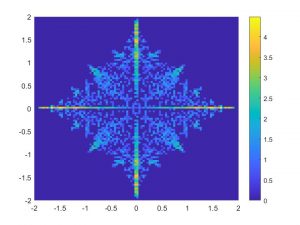
Images of fractal structures courtesy of Henry Taylor
Contacts
Please contact Louisa Bartoszewicz regarding any administrative aspects of the conference.
Organising committee:
Thomas Bothner (University of Bristol)
Tamara Grava (University of Bristol; International School for Advanced Studies (SISSA/IAS)
Ken McLaughlin (Colorado State University)
Andrei Prokhorov (University of Michigan)
